Straight answer: a CEO's LinkedIn profile usually fails to deliver for three reasons — no consistency (a post once a month gets lost), no clear positioning ("what are you actually about"), and no system that doesn't demand hours every week. The fix isn't writing more. It's turning writing into a repeatable process backed by a clear strategy. The rest of this article breaks down each point in practice.
Why most CEOs quit after a few weeks
The typical arc: a CEO decides to get active on LinkedIn. Week one, two posts go out, a few likes come in, it feels good. Week two, it's one post, because work got busy. Week three, nothing — and the profile quietly settles back into whatever it was before.
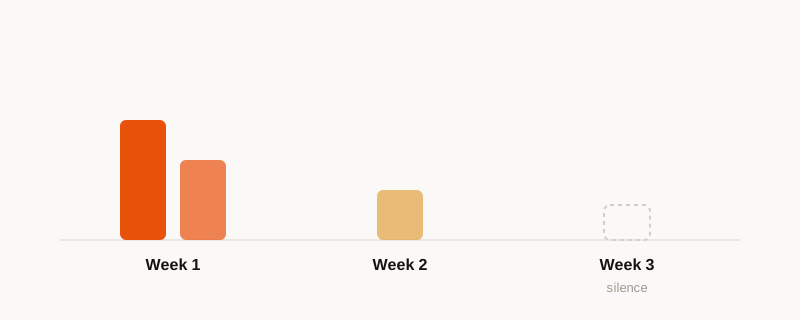
It isn't a discipline problem. It's a question of what you expect writing on LinkedIn to do for you. When the only metric is "post regularly," it's just one more tiring obligation. When the metric is "build a specific perception with specific people," every post matters even in the week you don't publish one.
Positioning has to come before content, not the other way around
The most common mistake isn't bad writing — it's writing without an answer to the question: "When someone reads this profile, what will they think of me three months from now?" Without a clear answer, you get content that's technically fine but goes nowhere. Prospects won't remember what you're about, because you were about everything and nothing.
A system, not inspiration
Relying on "sitting down each week and writing something good" is the weakest link in the whole chain. It works for a week or two, then a busy calendar hits and writing is the first thing to go. A system that survives a busy week needs three things:
- Topics decided in advance — you're not deciding "what today," you decided a month out.
- A short approval window, not writing from scratch — 15–30 minutes to edit a finished draft, not an hour staring at a blank page.
- A clear success metric that isn't "how many likes" — e.g. how many specific people from your target audience sent a message or booked a call.
Three common excuses — and why they don't hold up
Before the numbers, it's worth naming the three reasons CEOs most often give for why they're not doing this "yet." All three sound reasonable. None of them survive contact with how the system actually works.
- "I don't have time for this." The time doesn't go into writing from scratch — it goes into deciding what to write about and scrambling for inspiration at the last minute. With topics planned a month ahead, that time shrinks to approving a finished draft, which is exactly the short-approval-window point above.
- "I don't know what to say without sounding like everyone else." This is the positioning problem from the section above, not a lack-of-ideas problem. Clear positioning generates topics on its own — the question isn't "what to write about," it's "what would someone with my specific view of this say."
- "I'm worried it'll sound unnatural or too polished." The fix isn't posting less often — it's writing things only someone with your specific experience could say, instead of generic advice anyone in your field could have written.
What a week that works actually looks like
Concretely, not theoretically: Monday morning, an email arrives with a finished draft for Wednesday's post — built from a topic planned three weeks earlier. The CEO reads it on the way to his first meeting, edits one sentence that doesn't sound like him, and approves it. Ten minutes, not an hour.
Thursday, a second draft arrives — this time a reaction to something that actually happened on the team, an opportunity he never would have thought to turn into content himself, but one that fits the positioning exactly. Another ten minutes to edit and approve. That's two posts published in a week, zero hours spent staring at a blank page, and a profile that's been moving consistently for its third month running.
This isn't about having more discipline than other CEOs. It's about the system removing the exact two steps — deciding on a topic, fighting a blank page — where most people stall out by week two.
What the path from zero to results actually looks like
This isn't just "post consistently and you'll see results." It's a specific process we take every client through, from the first call to the monthly review.
- Discovery call. We go through the business, the target audience, and what the profile actually needs to deliver, sales, hiring, or both.
- Magnetic identity and unique mechanism analysis. We find what genuinely makes the business distinct, not just generically good like dozens of similar companies in the field.
- Voice audit. We review how you already talk and write, emails, presentations, past posts, so the content sounds like you, not a generic copywriter.
- Content pillars and positioning. The analysis produces 3 to 5 recurring themes the content is built on, and a clear position you'll occupy in your industry.
- Voice guide and an off-limits list. Written rules for how to write, which words to use, and which topics or phrasings never appear.
- Content engine. Regular production, 3 to 4 posts a week, each one approved before it goes live. Nothing goes out without your sign-off.
- Monthly review. What worked, what didn't, and how to adjust course for the next month based on real data, not a hunch.
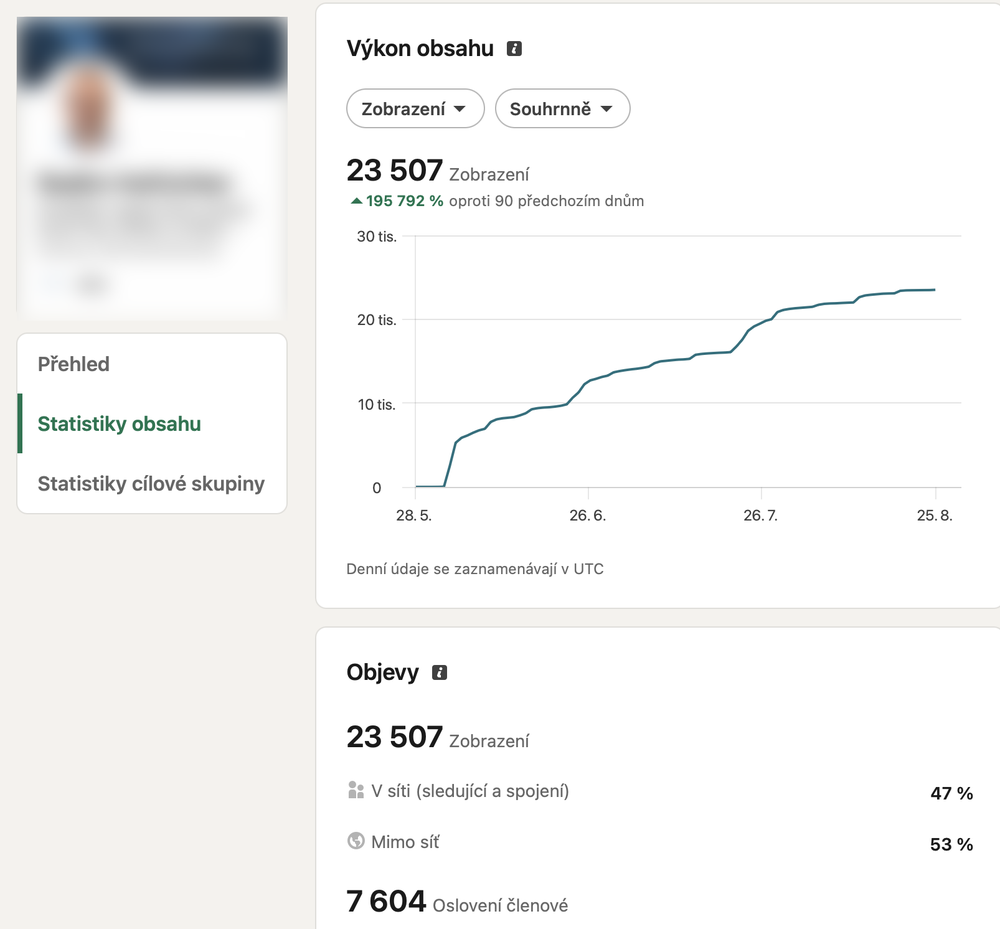
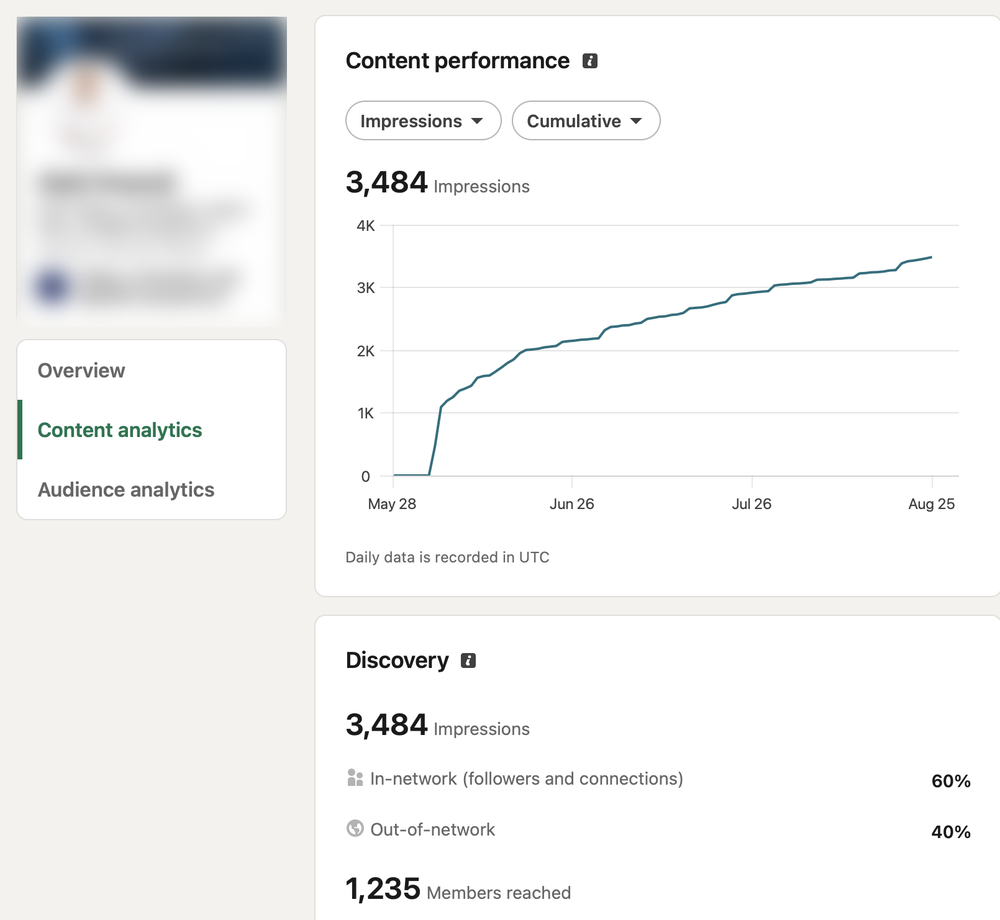
We ran both of these clients through this exact process. The images below are straight from their own LinkedIn Analytics.
The first client went from essentially zero activity to 23,507 impressions over 90 days, a 195,792% increase versus the previous 90 days, and reached 7,604 people, 53% of them outside his own follower network.
A second client started from a similar point, a profile almost nobody followed. Through the same process he had 3,484 impressions and reached 1,235 people over 90 days, four in ten of them outside his network.
What a client typically has after 90 days
- A publishing system that runs without daily involvement, just approving a finished draft
- A clearly stated positioning that sets him apart from others in the same field
- New connections and specific inquiries from people who didn't know him before
- Material usable beyond LinkedIn, in presentations, hiring, or PR communication
- A stronger position in sales conversations, because the other side already knows him from the content, not from zero
Where to find your positioning if you don't have one yet
The fastest route isn't inventing positioning at a desk — it's looking back over the last 12 months and finding the pattern in what's already working. Three specific questions help:
- Which decision do you still stand behind in hindsight, even though it was unpopular at the time? That's story material, not theoretical advice.
- What do people in your industry ask you repeatedly, in meetings and outside them? That question is a signal for what the market expects to hear from you.
- Which piece of experience would you hand off to a successor if you left the company tomorrow? That's usually the one thing no one else in your field can say quite the way you can.
The answers to those three questions are usually enough to cover a first month of content — and they define positioning better than an hour of brainstorming at a blank whiteboard.
Want to find out exactly where your signal is leaking?
The audit covers your positioning, content, and profile as seen from outside, with concrete next steps instead of generic advice. A personalized PDF report within 24 hours.
Get my profile audited →