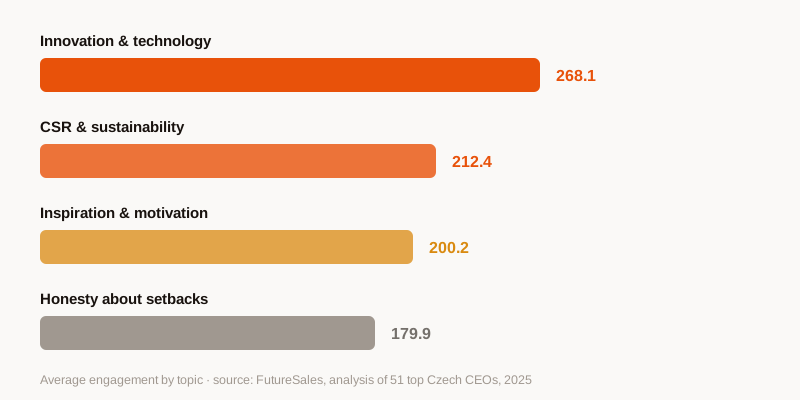
Nearly a fifth of everything Czech CEOs post on LinkedIn is lifestyle content — vacations, sport, family, motivational photos from a race. According to an analysis of 7,044 posts from the 51 most influential Czech leaders in 2025 (FutureSales), that's also one of the weakest categories for engagement on the platform. What performs best instead: innovation and technology (average engagement 268.1, 40% more reactions than marketing posts), CSR and sustainability (212.4), and — perhaps surprisingly — honestly admitting a mistake or a worry about a crisis (179.9), even though that type of content makes up only 10% of total volume.
What exactly the analysis measured
The data comes from profiles that met clear criteria: a CEO title or equivalent (managing director, board chair, owner), a company with more than 51 employees, primary location set to Czechia, and posting for at least three consecutive months. Out of 13,000 unique profiles, that filter produced a core group of 51 top influencers — and their 7,044 posts from 2025 form a large enough sample to talk about patterns, not coincidence.
The most common words in these posts: thanks, future, people, team. Nothing surprising — it's vocabulary that sounds safe and offends no one. The question is whether it's also vocabulary that convinces anyone.
The emotion that wins isn't joy
An emotional analysis of the same sample found that the strongest reaction on Czech LinkedIn isn't triggered by inspiration or pride — it's surprise, with an average engagement of 275.8, the highest of any emotion measured. Fascination with an unexpected technological leap, a statement nobody saw coming, a number that doesn't match what the reader assumed — that's what performs best.
Inspiration works. Surprise works more. And both work better than anything that sounds like it could have been written by anyone else in the same seat.
The paradox of safe content
Here's the contradiction hiding in those numbers: the content a CEO decides to publish most easily — a lifestyle photo, a generic thank-you to the team, a motivational quote — is also the content that requires the least courage. And that's exactly why it blends into hundreds of similar posts from anyone else in a similar seat. Content that requires courage — admitting a mistake, showing a specific number from your strategy, saying something someone could push back on — is the content that ends up getting the most attention.
LinkedIn's 2026 algorithm also weighs saves more heavily than likes, and what gets saved is mostly things with reference value, not generic greetings. Klaus Zellmer, CEO of Škoda Auto, didn't guess at this, he ran a poll among his own followers asking what they wanted to read about. Strategy came out on top, followed by leadership and his own way of working. Not vacation photos.
What to do with this if you run a CEO's LinkedIn presence
- Replace generic thank-yous with a specific scene. Swap "thanks to an amazing team" for what the team actually solved and what it took.
- Show something that didn't work out, once in a while. Not as self-pity, but as a fact with a lesson — this exact type of content sees above-average engagement despite low volume.
- Replace the motivational quote with your own number. Strategy, a decision, its impact — that's what followers actually want to read, far more than polls like Zellmer's suggest they'd admit outright.
- Aim to surprise, not confirm. A post that just repeats what the reader already believed lands flat. A post that shows them an angle they didn't expect doesn't.
Three rewrites — what this looks like in practice
Theory is nice, but this shows best side by side. Here are three of the most common post types on Czech LinkedIn, and what they might look like aimed at what the data actually shows works:
Thanking the team. Safe version: "Grateful for an amazing team, without whom none of this would be possible." Specific version: "This quarter we had to replan the product three weeks before launch. The team pulled it off without a single slip — and I learned that a team's decision speed depends more on trust than on hierarchy."
Motivational quote. Safe version: "Success isn't a destination, it's a journey." Specific version: "Last year we turned down a deal worth 8 million because it didn't fit our strategy. I know now it was the right call — it didn't feel that way on the day."
Announcing a result. Safe version: "Proud to announce a record quarter!" Specific version: "A record quarter, not because of one big move — because for three months straight we kept saying no to anything that didn't touch the core product."
In all three cases, the difference is the same: the safe version is a sentence anyone in the same seat at any company could have written. The specific version is a sentence only someone this actually happened to could have written.
Want to know exactly where you stand?
The audit shows you whether your profile belongs to the safe majority, or to the kind people actually save. A personalized PDF report within 24 hours.
Get my profile audited →Back to that opening number: a fifth of content on Czech LinkedIn is lifestyle, because it's the easiest thing to publish without risk. But the data shows that exact safety is why it blends in. The most influential Czech CEOs aren't the ones posting the most — they're the ones willing to write something no one else in their seat would.